
When Your Brain Won’t Quiet Down: A Look at Dystonia and Anxiety
One of the hardest things about living with dystonia is trying to explain what it feels like on the inside. People often see (not always for some) the muscle contractions, the pulling, the tension — but they don’t see the constant noise happening in the brain. They don’t see how exhausting it is to live in a body that won’t fully cooperate, or how that physical chaos spills into our emotional world.
For a long time, I couldn’t understand why my body felt tense and on edge all the time, or why anxiety seemed to show up even when nothing “stressful” was happening. It wasn’t until I learned more about the brain that things finally clicked.
The part of the brain that won’t stop talking
Dystonia starts deep in the brain, in a place called the basal ganglia. These structures act like traffic controllers for movement — deciding what signals should go through and which ones should be quieted down.
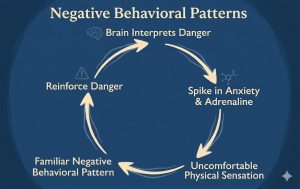
In dystonia, that system breaks down. The brain sends too many “move” signals and not enough “relax” signals. The result is a constant stream of mixed messages firing into the muscles, just like the mixed messages in the image below. It’s not subtle. It’s not quiet. It’s not something you can just ignore. It feels like your nervous system is always humming, always working, always trying to correct something it can’t quite fix.
When the Body Feels Unsafe, the Mind Follows
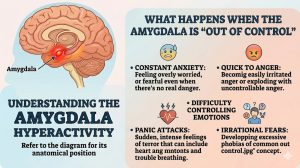
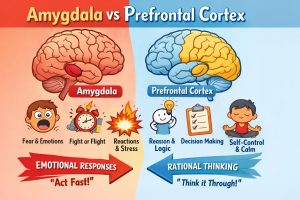
The basal ganglia aren’t just about movement. They’re connected to the limbic system, the part of the brain that handles emotion — especially fear, threat, and anxiety. So when the motor system is overactive, the emotional system – the amygdala – gets dragged along for the ride.
The brain senses the constant muscle tension, the loss of control, the internal “noise,” and it interprets it the same way it would interpret any other threat. Not because you’re imagining danger, but because your nervous system is literally signaling that something is wrong.
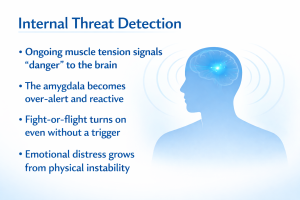
This can create:
– A constant feeling of being “on alert”
– Anxiety that seems to come out of nowhere
– A sense of fear or unease that doesn’t match the situation
– Difficulty calming down, even when you want to
It’s not psychological weakness. It’s not overreacting. It’s biology. Your brain is trying to protect you — it just doesn’t realize the danger is coming from inside the system itself.

Living in a Body That Won’t Settle
When your muscles are contracting involuntarily, your brain never gets the “all clear” signal. It never gets to fully relax. And when the body can’t settle, the emotional centers can’t settle either. This is why so many people with dystonia describe feeling:
– Hypervigilant
– Overstimulated
– Easily overwhelmed
– Emotionally raw
– Stuck in fight-or-flight
It’s not “just stress.” It’s the nervous system doing exactly what it’s wired to do — respond to threat — even when the threat is internal and unintentional.
If you live with dystonia, or love someone who does, here are the truths that matter:
– Dystonia is a neurological disorder: The symptoms are real, physical, and rooted in the brain’s motor circuits.
– It’s not just a muscle problem: It’s a whole-network issue involving movement, sensation, and emotion.
– The emotional impact is part of the condition, not a character flaw: Anxiety, fear, and hyperarousal are natural responses to a body stuck in overdrive.
Understanding this doesn’t magically make the symptoms disappear, but it does bring a sense of validation. It helps you see that your reactions make sense. That your body isn’t betraying you — it’s trying, in its own confused way, to protect you. And sometimes, just knowing that can bring a little more compassion to the experience.
Strategies for Managing the “Noise”:
Sensory regulation: Since the brain is already overstimulated, reduce external noise. Use noise-canceling headphones, dim the lights, or spend time in quiet, predictable environments to help your amygdala feel a sense of safety.
Vagus nerve stimulation: Techniques that stimulate the vagus nerve can help shift the body from “fight-or-flight” to “rest-and-digest.” Try slow, deep diaphragmatic breathing (exhaling longer than you inhale), gentle humming, or cold water splashes on your face.
Sensory tricks: Many people with dystonia find that light touch or specific movements can temporarily interrupt the faulty signaling. Identify what physical actions or textures help quiet your specific symptoms and use them as grounding tools when the tension spikes.
Focus on pacing, not productivity: Living with dystonia is physically taxing. Break tasks into tiny, manageable bites and build in “non-negotiable” rest periods before you feel exhausted. This prevents your nervous system from hitting a state of total depletion.
Mindful movement: Exercises or movements that don’t trigger symptoms, yoga, tai chi, or somatic movement therapy. These practices emphasize body awareness and slow, intentional movement, which can help retrain the brain-body connection.
______________________
 Tom Seaman has lived with dystonia since 2001 and devotes his life to worldwide education and awareness for this life changing disorder. He is the author of 2 books: Diagnosis Dystonia: Navigating the Journey, and Beyond Pain and Suffering: Adapting to Adversity and Life Challenges, as well as hundreds of articles on dystonia, pain, and emotional health topics. Tom is a Certified Professional Life Coach in the area of health and wellness, working directly with people to help them manage their physical, emotional, social, and vocational challenges. He is also a motivational speaker and chronic pain and dystonia awareness advocate. Tom is also a volunteer writer for Chronic Illness Bloggers Network, The Mighty, and Patient Worthy. To learn more about Tom, get a copy of his books, or schedule a free life coaching consult, visit www.tomseamancoaching.com. Follow him on Twitter @Dystoniabook1 and Instagram.










Thank you Tom for sharing this article. I also have had OCD as far back as I can remember. I finally got help during the pandemic with Zoloft.
I was recently diagnosed with Dystonia even though I believe I have had it for quite some time.
However, I know the Dystonia has gotten worse after I started using Zoloft.
Have you heard this before, if so, what can be done?
Thank you
Hi Sylvia. I have recently heard more and more people with dystonia talk about OCD. While I am glad to hear that Zoloft helped with that, I am sorry that it made your dystonia worse. Antidepressants are a class of meds that are thought to contribute to the onset or worsening of movement disorders, so there might be a connection. I would discuss other options with your doctor.
I have had Dystonia for Years. OCD Is a big part of it also. Do you find many people have this condition akso?
I have also had OCD for most of my life. I hear that a lot from people with dystonia. It is apparently up to 20% more likely for people with dystonia to have OCD.
This article is very helpful. Every dystonia patient must be educated on this. Thank you Tom.
Thank you very much.
Yes please do!
Fantastic article, makes me understand my reason for anxiety and that unsettled feeling in my stomach. Thank You!
Thanks Linda! I’m glad this helps!
This is so helpful. I have been struggling to understand why my body remains locked in fight or flight, especially when the dystonia symptoms are bad. Thanks for this Tom, and for the tips for managing it. It does bring some compassion into the picture when I can understand my body is simply trying to protect me.
I am glad to hear it was helpful. I am doing a presentation in Washington in October with the NSTA and Dr. Patrick Hogan that goes into this topic in more detail. It will be recorded so I will be sure to share it.