Why Does My Body Panic When I’m Safe? Understanding the Brain’s Background Programs
Have you ever found yourself in a completely ordinary, non-threatening situation—maybe at the grocery store or making friendly small talk with a friend or neighbor—only to suddenly feel your neck seize up, your muscles lock, or your symptoms flare? If you are like many of the people with dystonia, including myself, your immediate reaction is confusion and frustration: “This makes no sense! I wasn’t stressed. Nothing bad was happening.”
When your body reacts like there’s an emergency when you are objectively safe, it’s easy to feel betrayed by your own nervous system. But there is a very logical, biological reason why this happens. To understand it, we have to look at how our brains are wired behind the scenes.

The Invisible Background Programs
Think of your mind like a computer. When you are sitting at your desk typing an email or browsing the web, you only see what’s on your active screen. But beneath the surface, your computer has dozens of invisible processes running in the background—checking for updates, scanning for security threats, and managing memory.
Your brain operates the same way. The conscious part of your mind—the part that says, “I’m just chatting with a friend, everything is fine”—is only the tip of the iceberg. Deep down in the older, primitive layers of the brain, survival programs are running 24/7. Their sole job is to scan the environment for danger and keep you safe.
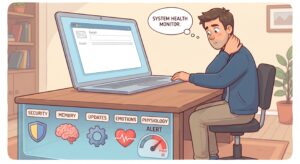 Because of chronic stress, nervous system sensitization, or chronic uncomfortable physical symptoms, your brain’s background security system has been turned up to a hyper-vigilant volume. It is no longer waiting for a physical threat; it is scanning social interactions, environmental shifts, and internal sensations for vulnerability. In my presentations, I often describe it as someone sitting on the couch in the safety of their own home but feel as though there is a bear at their door. Or the example of feeling like we are running from a lion when no lion is actually chasing us.

Why a Friendly Chat Can Trigger a Physical Lockup
When your nervous system is stuck in this high-alert state, it views the world through a lens of protection rather than connection. Even a simple, friendly face-to-face conversation requires subtle forms of vulnerability: maintaining eye contact, reading facial expressions, and regulating your posture. These are HUGE challenges for those of us with health conditions where we look different, like in the case of dystonia where parts of the body are being involuntarily moved in awkward positions.
To an over-protected nervous system, that vulnerability can register as a risk. Before your conscious mind even has a chance to weigh in, those background programs kick into high gear. They sound a silent alarm, flooding the body with protective tension. For someone with dystonia, chronic pain, or stress-induced symptoms, that protection often shows up as a familiar physical pattern—like the neck seizing up or tremoring, or both.
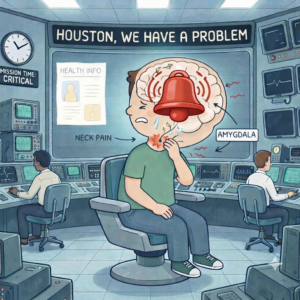
It isn’t a malfunction; it is an over-protection. Your body is trying to brace you for a threat that isn’t actually there. The more we have been like this, the stronger the brain circuitry is for that to happen, but this can all be rewired with the proper techniques, which is what I do with my coaching clients.
Practical Techniques to Signal Safety to the Brain
When those background programs misfire and your body goes into a protective brace, telling yourself to “just relax” rarely works. The thinking brain cannot simply argue with the survival brain. Instead, you have to use physiological cues to communicate safety directly to the nervous system. In other words, you need to use your body to trigger feelings of safety and rewire the “everything is dangerous” neural pathways in the brain.
Shifting from Frustration to Compassion
If you experience this, the first and most important step is changing how you talk to yourself about it.
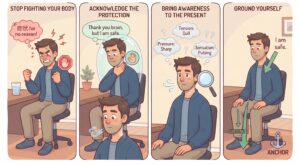
- Stop fighting your body: When you get angry at your symptoms for “acting up for no reason,” you send another wave of stress through the nervous system, confirming to your brain that something is wrong.
- Acknowledge the protection: Instead of thinking, “What is wrong with me?” try reframing it: “My brain is just trying to protect me right now, even though it’s working overtime. Thank you brain, but I am safe.”
- Bring awareness to the present: When you notice the tension rising during an interaction, become aware of the sensation and let it be what it is without resistance or judgment. Just notice it without reacting to it. Describe it (is it sharp, dull, stabbing, etc.?) and just be with it. If you run or immediately try and stop/fix it, the brain will stay on high alert and amplify the symptoms, which is why this approach almost never works.
- Ground yourself: Use one of the somatic grounding tools below to remind your physical self of what your logical mind already knows: Right here, right now, I am safe.
Below are a few in-the-moment techniques you can use when your body starts to lock up:
- Extended Exhales (The Physiological Sigh): When we feel threatened, we tend to take short, shallow inhales. To reverse this, take a deep breath in through your nose, followed immediately by a second quick sip of air, and then release a long, slow, sighing exhale through your mouth (making the exhale twice as long as the inhale). This instantly stimulates the vagus nerve, signaling the heart rate to slow down and turning down the body’s alarm system.
- Orienting to the Environment: Trauma and hypervigilance narrow our focus inward and tunnel our vision. To gently pull your nervous system back to the present, break the trance by slowly rolling your eyes around the room, naming three neutral objects you see (e.g., “a blue chair, a wooden table, a green plant”), and feeling the solid support of the floor beneath your feet. This proves to your primitive brain that the immediate environment is secure.
- The Butterfly Hug (Bilateral Stimulation): Cross your arms over your chest so that your right hand rests on your left shoulder/upper arm and your left hand rests on your right. Alternatingly tap your left and right hands in a slow, rhythmic heartbeat cadence while taking steady breaths. This rhythmic bilateral input helps ground an activated nervous system and reintegrates brain activity.
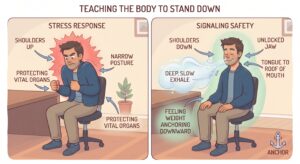
- Drop the Shoulders and Widen the Stance: Under stress, we instinctively pull our shoulders up toward our ears and narrow our physical posture to protect our vital organs. Consciously drop your shoulders down, un-lock your jaw, press your tongue gently to the roof of your mouth, and feel the weight of your body anchoring downward.
Feeling at ease isn’t about forcing your body to relax; it’s about patiently teaching those background programs that they can finally stand down.
After 25 years living with dystonia, I know navigating chronic symptoms and an overactive nervous system can feel lonely and overwhelming, but you don’t have to figure it all out by yourself. If you’re looking for guidance, personalized tools, or a supportive space to help untangle these physical and mental patterns, sign up for a free consult with me to see if personalized coaching might help. Visit www.tomseamancoaching.com to see how we can work together. Please also see my two books for more information on this and other related topics: Diagnosis Dystonia: Navigating the Journey, and Beyond Pain and Suffering: Adapting to Adversity and Life Challenges.
______________________
 Tom Seaman has lived with dystonia since 2001 and devotes his life to worldwide education and awareness for this life changing disorder. He is the author of 2 books: Diagnosis Dystonia: Navigating the Journey, and Beyond Pain and Suffering: Adapting to Adversity and Life Challenges, as well as hundreds of articles on dystonia, pain, and emotional health topics. Tom is a Certified Professional Life Coach in the area of health and wellness, working directly with people to help them manage their physical, emotional, social, and vocational challenges. He is also a motivational speaker and chronic pain and dystonia awareness advocate. Tom is also a volunteer writer for Chronic Illness Bloggers Network, The Mighty, and Patient Worthy. To learn more about Tom, get a copy of his books, or schedule a free life coaching consult, visit www.tomseamancoaching.com. Follow him on Twitter @Dystoniabook1 and Instagram.